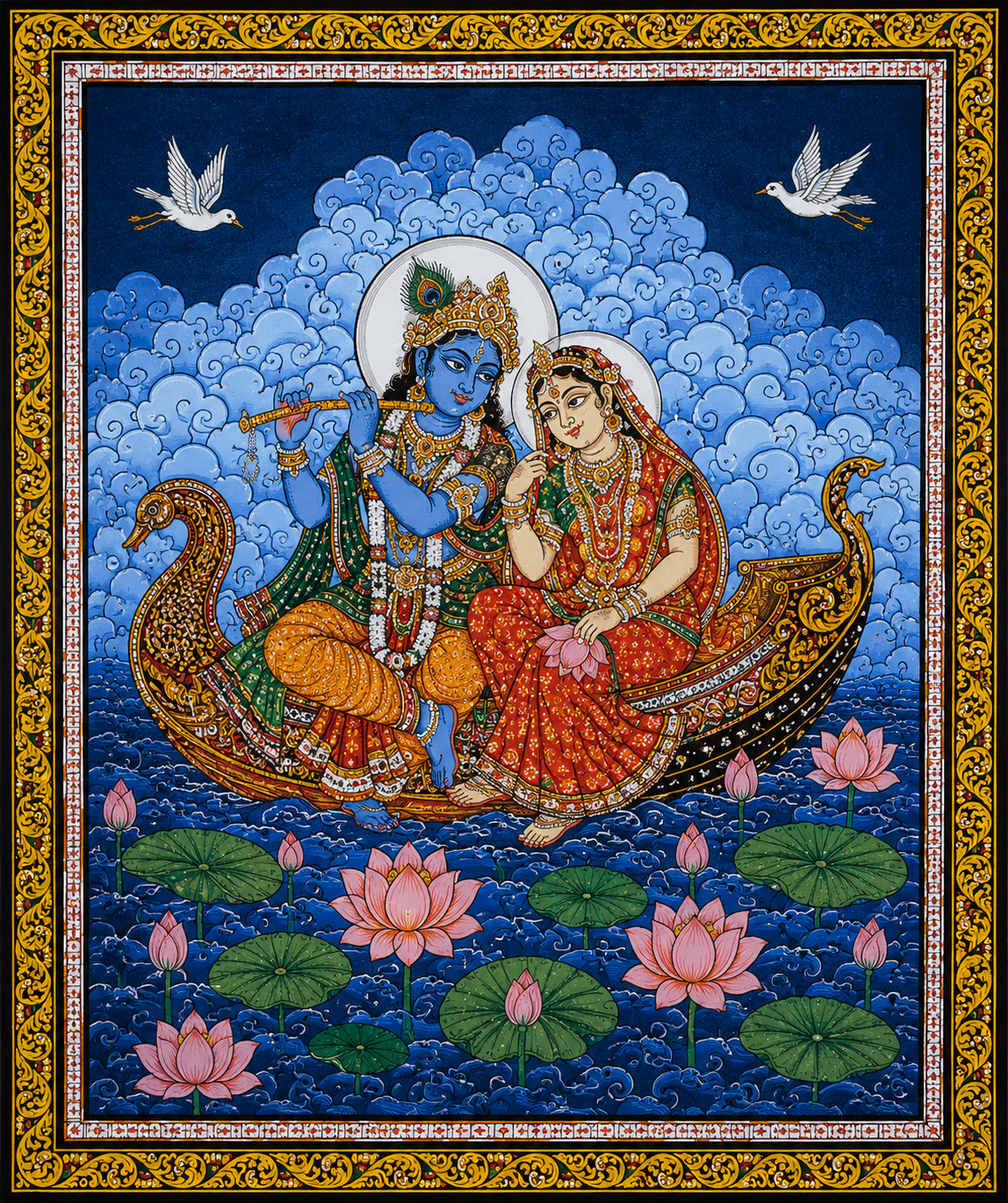
There is an art form in India so ancient that it predates the printing press, the camera, and the internet by several centuries — and yet it feels more alive today than ever. Pattachitra, the scroll painting tradition of Odisha and West Bengal, has been telling stories in vivid colour and intricate line work for over a thousand years. And today, those same stories are finding new walls, new homes, and new admirers around the world.
At ArtiSun India, Pattachitra is one of our most beloved craft categories — and for good reason. Every piece is a window into a world where mythology, devotion, and extraordinary skill come together in a single image. This post is an introduction to that world.
What is Pattachitra?
The word Pattachitra comes from the Sanskrit words patta (cloth or leaf) and chitra (picture or painting). It is, quite literally, a picture on cloth — though today the tradition also extends to palm leaf, tussar silk, and specially prepared paper.
The tradition originates primarily in two regions: Raghurajpur village near Puri in Odisha, and the Medinipur and Birbhum districts of West Bengal. While both traditions share roots, they have developed distinct visual vocabularies over the centuries — the Odishan style is bold, structured, and deeply devotional, while the Bengali Patachitra (note the slightly different spelling) is narrative, folk-inflected, and often accompanied by songs called pater gaan.
Pattachitra was granted a Geographical Indication (GI) tag by the Government of India, recognising it as an authentic cultural product of its region of origin.
A tradition with roots in temple culture
Pattachitra did not begin as a fine art. It began as a devotional necessity. The master artists of this tradition — called Chitrakars — were originally employed by the Jagannath Temple in Puri to paint the ritual images of Lord Jagannath, Balabhadra, and Subhadra during periods when the deity's idol was ceremonially unavailable to devotees.
These portable painted scrolls served as a substitute for the idol — devotees could carry the deity's image with them, worship it, and return it to the temple. The act of painting was itself considered sacred. A Chitrakar family did not simply make art for a living; they maintained a living relationship with the divine through their craft.
This deep spiritual grounding is why Pattachitra paintings feel different from decorative art. They are not designed to be aesthetically pleasing in the modern sense — though they certainly are. They are designed to communicate a sacred narrative with absolute clarity and fidelity. Every element in the composition has meaning. Every colour carries symbolism. Every gesture of every figure follows a visual grammar that has been refined over a thousand years.
How a Pattachitra is made — the process
The making of an authentic Pattachitra is an elaborate, multi-stage process that involves no modern materials whatsoever. Understanding this process is essential to appreciating what you hold when you own one.
Step 1 — Preparing the canvas
Traditional Pattachitra is painted on patta — a specially prepared cloth canvas. Layers of cotton cloth are glued together using a paste made from tamarind seeds. This layered cloth is then coated with a mixture of chalk powder and tamarind paste, applied by hand, and smoothed to a fine finish. The result is a semi-rigid, naturally primed surface that accepts natural pigments beautifully. This preparation alone can take several days.
Step 2 — Natural colour preparation
Pattachitra artists traditionally prepare all their own colours from natural sources. White comes from conch shells ground to fine powder. Black is made from lamp soot. Red and yellow are derived from minerals and plant sources. Green comes from leaves. Blue, historically rare and precious, was sourced from a specific stone. These pigments are mixed with a natural binding agent — traditionally the sap of the Kaitha tree — to produce paint that adheres permanently to the surface and retains its vibrancy for generations.
Step 3 — The border first
Every Pattachitra begins with its border. Before a single figure is drawn, the artist defines the sacred boundary of the composition — a decorative frame of flowers, creepers, or geometric motifs that contains and consecrates the pictorial space within. This border is not an afterthought; it is the first act.
Step 4 — Drawing in natural ink
The composition is drawn freehand using a fine brush made from the hair of a mongoose or squirrel tail. There are no pencil sketches, no grid lines, no underdrawing with correction fluid. The Chitrakar draws from memory — from a visual vocabulary absorbed over decades of practice and apprenticeship. The lines are clean, confident, and final.
Step 5 — Filling colours
Colours are filled in a specific traditional sequence — lighter tones first, darker ones layered over. Multiple coats are applied to achieve the characteristic flat, luminous quality of Pattachitra colour fields. The figures are always depicted in profile or three-quarter view, with large, elongated eyes, and stylized features that follow classical conventions.
Step 6 — The final outline
Once the colours are complete, the artist reinforces all outlines with a final pass of black ink. This is what gives Pattachitra its signature graphic crispness — the bold, confident black line that holds the entire composition together.
Step 7 — Lacquering
The finished painting is burnished with a piece of cloth and then coated with a natural lacquer derived from the resin of the Kuthali tree. This final layer seals the pigments, intensifies the colours, and gives the surface its characteristic warm sheen. It also provides protection against humidity and insects — allowing a well-made Pattachitra to survive for generations.
The visual language of Pattachitra
Pattachitra has a distinct and immediately recognisable visual style. Understanding its conventions helps you read the painting, not just look at it.
- Figures are always stylized, never realistic. The human form in Pattachitra follows classical conventions — large eyes, elongated limbs, graceful gestures. This is not a limitation of skill; it is a deliberate visual grammar developed over centuries.
- Colour is symbolic, not naturalistic. Red backgrounds often indicate divinity or power. Black outlines define and contain. White is associated with purity. Yellow and gold signal auspiciousness.
- Composition is narrative. Most Pattachitra paintings tell stories — episodes from the Ramayana, the Mahabharata, the Bhagavata Purana, or the specific mythology of Lord Jagannath. Reading a Pattachitra is like reading a sacred graphic novel.
- Nature is present but stylized. Trees, flowers, and animals appear frequently but always in a conventionalised form — recognisable but transformed into the painting's visual world.
- Borders are integral. The decorative border is never optional or secondary. It defines the sacred space of the image.
The Chitrakar families of Raghurajpur
Raghurajpur, a small village about fourteen kilometres from Puri, is considered the heartland of Odishan Pattachitra. Every family in the village is a Chitrakar family — every household is an artist's studio. Children grow up watching their parents paint and begin learning the craft from the age of five or six.
The knowledge passes from parent to child, generation after generation, largely unwritten. The visual vocabulary, the colour recipes, the compositional conventions — all of this lives in the hands and eyes of the Chitrakar community, transmitted through practice rather than documentation.
Raghurajpur was declared India's first Heritage Crafts Village by the Odisha government, recognising the unique cultural significance of this living artistic tradition.
"In Raghurajpur, art is not a career choice. It is a birthright, a responsibility, and a way of being in the world."
Pattachitra in the contemporary world
Traditional Pattachitra artists have always adapted their art to new contexts without abandoning its essential character. Today, Chitrakar families create Pattachitra on a remarkable range of surfaces and formats — from large ceremonial scrolls to intimate greeting cards, from wall panels to lamp shades, from sarees to book covers.
Contemporary artists have also begun exploring new themes — portraits of modern figures painted in the classical Pattachitra style, depictions of everyday life, environmental subjects, and even collaborations with fashion and interior designers. These experiments are not a departure from tradition; they are evidence of a tradition healthy enough to grow.
International collectors, interior designers, and conscious consumers have discovered Pattachitra in increasing numbers over the past decade. A well-executed Pattachitra panel by a master Chitrakar is now considered serious fine art — and commands prices that reflect the extraordinary skill and time involved in its creation.
How to identify authentic Pattachitra
As with any valuable craft tradition, Pattachitra has attracted imitations — machine-printed reproductions and low-quality tourist versions that mimic the surface appearance without the substance. Here is how to recognise the real thing:
- The surface should have a slight rigidity and texture — not the smoothness of paper or canvas
- Colours should be flat and luminous, with a warm natural sheen from lacquering
- Outlines should be clean, confident, and hand-drawn — not mechanical or printed
- The reverse of the painting should show the cloth layers of the patta
- Minor variations and the evidence of handwork are signs of authenticity, not defects
- A genuine piece will be accompanied by information about the artist
At ArtiSun, every Pattachitra piece is sourced directly from verified Chitrakar families. We provide the name and background of the artist with every purchase — because we believe you deserve to know whose hands made what you own.
Bringing Pattachitra home
A Pattachitra painting is not just wall decor. It is a living document of one of humanity's oldest continuous artistic traditions. It is the work of a specific person — a Chitrakar who learned from their parent, who learned from their grandparent, in an unbroken chain stretching back through centuries.
When you bring a Pattachitra home, you are not buying an object. You are accepting a responsibility — to preserve, to appreciate, and to pass on a story that deserves to continue.
We think that is worth something. We hope you do too.